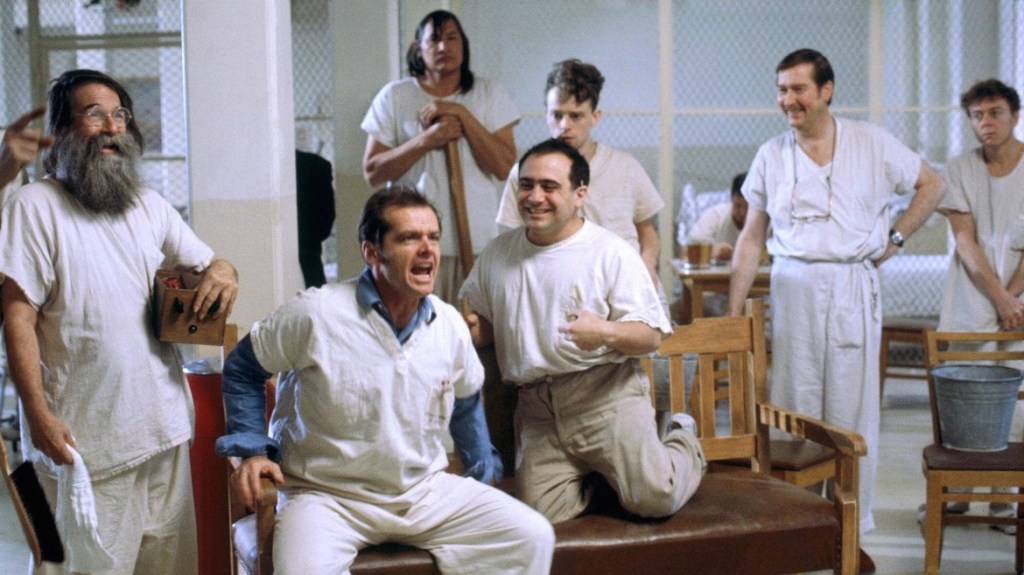
Directed by Miloš Forman
A poignant and powerful exploration of individuality, authority, and the human spirit. Set in a mental institution in the 1960s, the film follows Randle P. McMurphy (Jack Nicholson), a rebellious and free-spirited man who fakes insanity to avoid prison time. What begins as a game turns into a profound struggle against the dehumanizing forces of institutional control, embodied by the cold and calculating Nurse Ratched (Louise Fletcher).
One of the film’s greatest strengths lies in its unforgettable performances. Jack Nicholson delivers one of the most iconic roles of his career, bringing charisma, defiance, and vulnerability to McMurphy. His energy is magnetic, and his character’s journey from mischief-maker to tragic hero is deeply affecting. Opposite him, Louise Fletcher’s portrayal of Nurse Ratched is equally masterful—quiet, composed, and chillingly oppressive. The psychological battle between these two characters forms the emotional and thematic heart of the film.
The supporting cast—including Brad Dourif, Danny DeVito, and Will Sampson—add further richness and authenticity to the ensemble, portraying fellow patients with humanity and nuance. Forman’s direction is restrained yet intimate, allowing the characters and performances to take center stage. The setting of the mental hospital becomes a microcosm for society at large, where conformity and control often come at the expense of personal freedom.
The film’s emotional arc is both devastating and uplifting, culminating in a final act that is as symbolic as it is powerful. One Flew Over the Cuckoo’s Nest is not just a critique of institutional power, but a celebration of resistance and the irrepressible human spirit. Its impact is timeless, and it remains one of the most acclaimed and influential films in American cinema.
 Will's Top Ten Movies Ever Put to Screen