Directed by Francis Ford Coppola
A towering achievement in war cinema, blending psychological horror, philosophical depth, and visceral spectacle to create an unforgettable portrait of the Vietnam War—and the darkness within the human soul. Loosely inspired by Joseph Conrad’s Heart of Darkness, the film follows Captain Benjamin Willard (Martin Sheen) as he journeys up a river in Cambodia to assassinate the rogue Colonel Kurtz (Marlon Brando), who has gone mad and established himself as a godlike figure among local tribes.
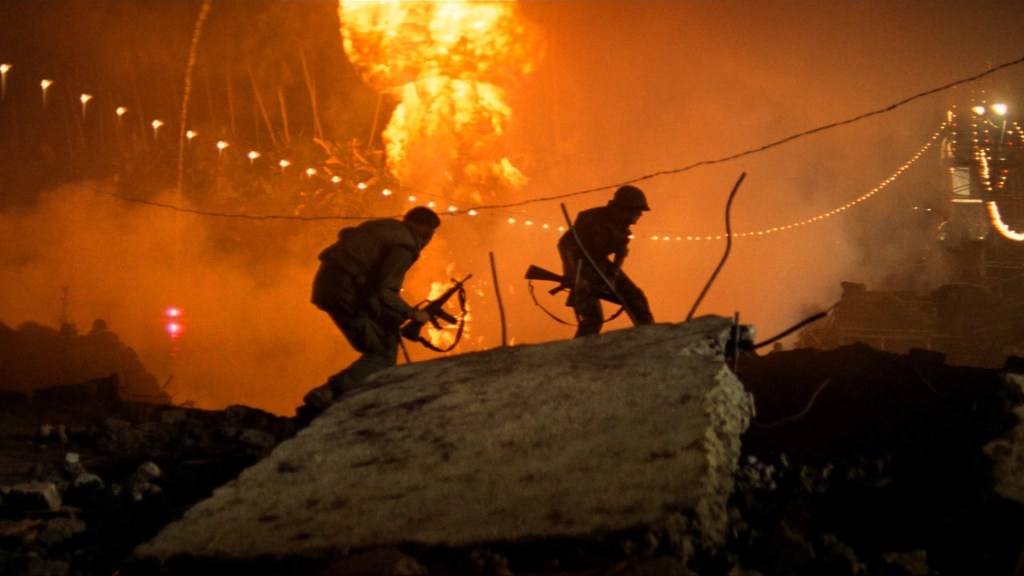
One of the film’s most striking strengths is its hallucinatory atmosphere. As Willard’s mission progresses, the film becomes increasingly surreal, reflecting the chaos and moral ambiguity of war. Vittorio Storaro’s Oscar-winning cinematography paints the jungle in fire, shadow, and fog, creating a haunting visual experience that borders on the dreamlike. Combined with Walter Murch’s innovative sound design and the haunting use of music—from Wagner’s Ride of the Valkyries to The Doors’ “The End”—the film builds an immersive, otherworldly tone that lingers long after the credits roll.
The performances are equally powerful. Martin Sheen conveys a quiet intensity and internal conflict as the emotionally fractured Willard. Marlon Brando, though appearing late in the film, delivers an enigmatic and unsettling performance as Kurtz, embodying the madness and moral collapse at the heart of the story. Robert Duvall also stands out as the bombastic Lt. Kilgore, whose obsession with surfing amid chaos offers one of the film’s most iconic and disturbing sequences.
More than just a war film, Apocalypse Now is a meditation on imperialism, insanity, and the thin line between civilization and savagery. Bold, chaotic, and relentlessly ambitious, it remains one of the most influential and daring films ever made—a nightmarish descent into the heart of war and human darkness.
 Will's Top Ten Movies Ever Put to Screen